
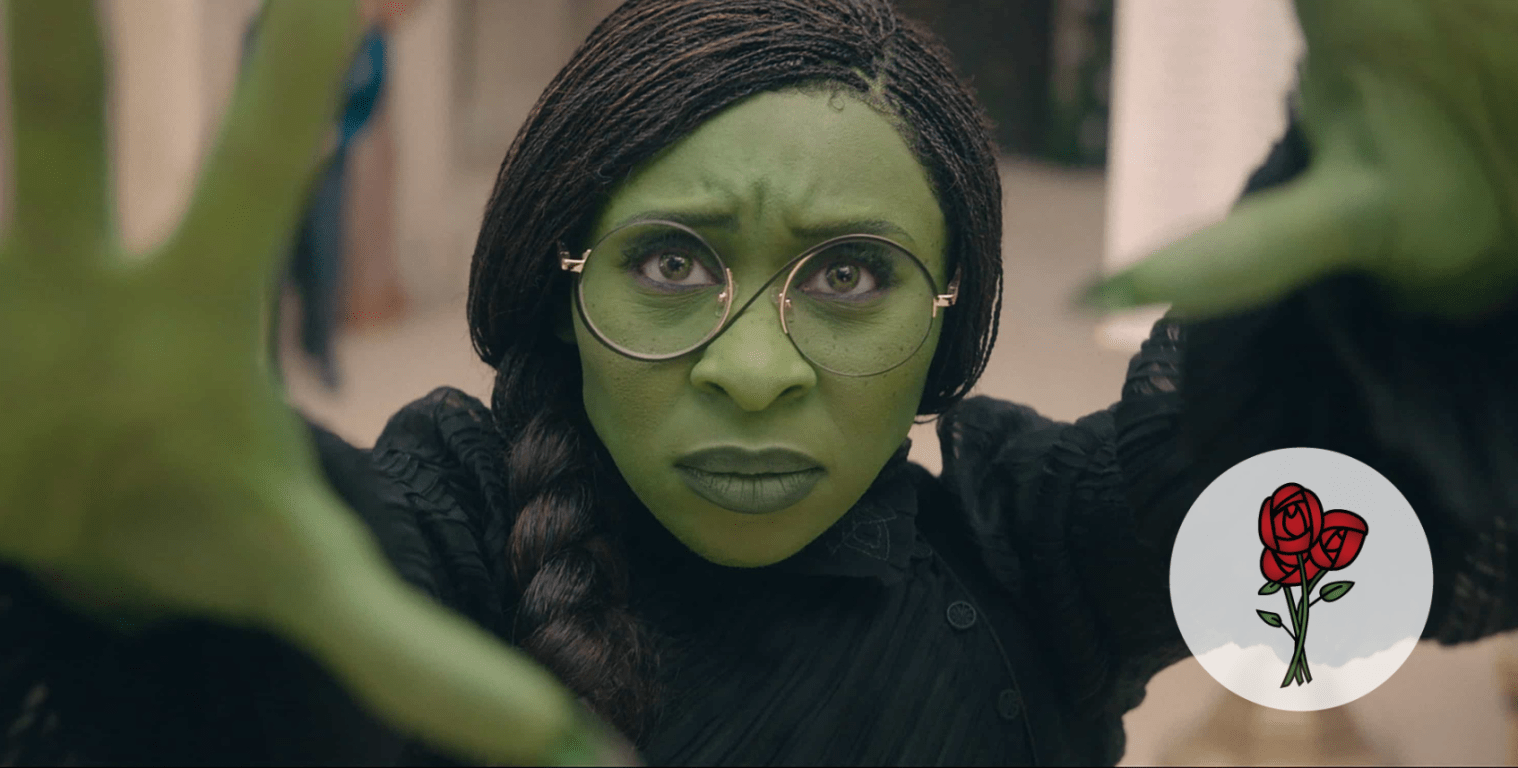
The first thing you must know about me is that I am an ex theater kid. If you’ve been here with me for a while, then that comes as no surprise to you. In fact, you may have already known that. That’s all to say that Wicked was the first ever Broadway musical soundtrack I burned from my grandparent’s computer. I even printed out the album cover to put in the case. Thus started my deep journey into, not just movie musicals (those had already been on my radar), but Broadway musicals, as well. I have loved the music and story of Wicked, like many others, for the last 20+ years and it was integral in shaping my teenage self. This movie, I know, has been in the works for the better part of at least 10 years. So, to finally be able to sit in a movie theater seat and see Wicked on the big screen…Twelve year old me was so excited.
Now, if you’ve ever talked about this exact subject with me in person, you’ll know what my opinion on a live action Wicked movie has been for a long time. Part of the success and longstanding nature of Wicked on Broadway is that it is such a spectacle on stage. To make Elphaba fly, create Oz in that space, it is fantastical. Film, itself, is already fantastical. So, my opinion has always been that it would be difficult to achieve the same effect, the same emotional connection and gut punch in a film environment, which would hinder a movie version. I’m happy to report that I was (mostly) wrong.
I want to start off with my negatives, but that’s because there are only two of them.
The first having to do with the technicalities of adapting a stage script into a film script. At the very end of “Defying Gravity”, there is a lot happening. The guards coming for Elphaba and Glinda, the chaos of the townspeople; when on stage, we can see these things all happening at once, all the dangers emerging towards Elphaba and Glinda. On film, however, unless you were to literally divide up the screen, these things all have to be shown in different shots, everybody in different locations (whereas, in a theater, they’re all on the same stage, in the same place). That in and of itself isn’t particularly a bad thing. However, when the build up to the end of the song (a very powerful song, might I add) is chopped up within the film because of this, it squashes the momentum. I had a more emotional reaction when I listened to the cast recording of “Defying Gravity” before seeing the film, than when I heard and saw the song in the context of the film. And I can tell you, for certain, that it was because that momentum at the end, that build up that you’re yearning for in the song, is briefly paused. It comes back, of course, and finishes strong. But, it was disappointing.

The second item to mention is the cinematography. I know I’m not the only one to harp on this. But, what was the thought process here? Was the idea to go pastel colors with loads of lens flare? I mean, if so, that’s fine, I suppose. I just think everybody was expecting, well, Oz in technicolor. Especially while we’re in a time, creatively, where so many films use colored filter overlays, making everything in tones of blue or yellow. We wanted some vibrancy. That was a disappointment. This is one that cannot be rectified for the sequel, as it wouldn’t flow visually as a pairing. So, I’ll live with this one. (Also, can we talk about how none of the marketing matched the tone of the title card? Because it was very jarring.)
The most positive notes I have for this film are for the costume design, the choreography, and the performances of Cynthia Erivo and Ariana Grande.
The choreography in this film itched my brain in a way that I don’t think has happened before. Christopher Scott did an incredible job. Particularly, any of the scenes with the students from Shiz. The synchronicity of their dances, the footwork, it was all so satisfying to watch. The “What Is This Feeling” sequence was so well done. I’m eager for Goldblum’s tap dance in Part 2. Now, for this film, I firmly believe that you can’t talk about choreography without also talking about the costume design and execution. During “One Short Day”, it’s clear that a large amount of thought went into, not only how the costumes would look on screen, but how the costumes would move on screen. It added depth to the visuals in such a pleasant way.

Now, I do not say this lightly when I say that Ariana Grande was absolutely born to play the role of Glinda. Did she bring anything new to the character of Glinda? No. But, she did do the role justice and paid lovely homage to “her Glinda”, Kristin Chenoweth, who was the clear influence here. Grande’s acting in “No One Mourns the Wicked”, the opening number, was particularly grabbing, as you could feel the guilt and see the sorrow on her face, as the true subject of the song is herself. You can feel the sadness, as she looks on at this wicker Wicked Witch. She stands there, staring, knowing that she helped to create this very image. Ariana Grande lives, breaths, and dies Glinda. That much is clear.

Cynthia Erivo breaths a bit of freshness into the role of Elphaba. Again, there’s not too much new being done here. She clearly handled this role with great love and care, knowing the weight of what it means to be playing Elphaba on the big screen. Her vocals stun, as they always do.
(Honorable mention for Ariana Grande’s comedic timing.)
Now, let’s discuss a couple of the themes in this movie, shall we?
Why did this movie make you uncomfortable? Why now? I can tell you two reasons. The first being the character of Glinda “the Good” and her performative activism. Throughout the movie that is all Glinda truly does. She sees her friend who is trying to make real change happen, and realizes that she doesn’t seem to care as much as Elphaba does about the Animals losing their ability to speak, their free will to do as they please. However, Glinda also recognizes that not caring would make her look horrendous in the eyes of her peers. So, she does things to make herself look better, and nobody around Glinda questions it because the intentions seem to be good. The biggest example of this involved Glinda and Doctor Dillamond. When we first meet Doctor Dillamond, Glinda (named Galinda at the time) gives Dillamond a hard time as he is unable to pronounce her name correctly, seemingly due to the kind of Animal that he is. Now, this is not without trying on Doctor Dillamond’s part. But, try as he might to properly say “Galinda”, he is ultimately unable to, leaving Glinda feeling irritated, disliking “the old goat”. It isn’t until after Doctor Dillamond has been taken away, and Elphaba is about to head to the Emerald City to meet the Wizard that Glinda decides to “do something”. This is also motivated by the fact that the object of her affection, Fiyero, seems to be taken by Elphaba’s willingness to right a wrong. So, in a split moment decision, Glinda announces to her fellow students that, in honor of Doctor Dillamond, she will be changing her name from Galinda to Glinda, since that’s the name he could pronounce. This is met with applause and cheering from those around her. This is an act that Glinda is able to do without actually inconveniencing herself. This act takes no effort. This act takes very little thought. This act does absolutely nothing for the cause at hand. It is performative. It is to make Glinda look better. It is to make herself feel better, to make up for her own shortcomings. She may care a little bit about the Animal cause. Just not so much that it inconveniences her day to day life.

In the movie Wicked, it is clear to anybody watching that what is taking place in the movie is morally wrong. It is bad. The Wizard, admitting to using the Animals as scapegoats, is the bad guy. The Animals certainly do not deserve what is happening to them. They are a pawn in the system. It is obvious that what is happening is being manipulated by those in power, The Wizard and Madame Morrible. It is clear what is happening is cruel. The parallels to what is currently happening in this country, the United States of America, cannot and must not be overlooked. Immigrants, legal and illegal, are being made out to be the scapegoats, when the reality is that this country runs and functions on immigrant labor, legal and illegal. Always has. Now, why you ask, can people clearly see and state that the “bad guys” in Wicked are Madame Morrible, The Wizard, and Glinda (yes, even Glinda), but refuse to properly draw the parallel? It’s because then, those that are the citizens of Oz have to admit and come to terms with the fact that they’ve been had. By a conman. Who cannot read the Grimmarie.
All through the past, we can look at works of art and deduce what was happening at that moment in history. Film is no different. This film is no different. The book and the musical have always been an allegory for Fascism. Wicked hits harmonies with our current state in this country and, unfortunately, those notes may be falling flat on some ears. You can clearly see who the bad guy is in the context of this film, can’t you?
*All images courtesy of Universal Pictures
Hard agree on the cinematography, but that was one of my only qualms as well. I hadn’t thought about the “seeing everything on stage simultaneously” versus seeing it in separate shots. That makes so much sense. Even having never seen Wicked on stage, I felt like those final moments kept pulling attention away from Elphaba in a crucial moment (though I do love Jeff, Michelle, and Ariana’s acting in those moments). I also like your distinction that the film (though it is adapted from the musical) is still its own piece of art that reflects the current moment. Great review!
Ah! Thank you! I also love Jeff, Michelle, and Ariana’s acting in the end, but it definitely took away from the buildup. I feel like, just to keep the emotion of the scene up, they should have had all running to the top of the tower, maybe over an instrumental section or something along those lines. That avoids cutting to the Wizard where he is, Madame Morrible where she is, and then to Glinda, who is at the top of the tower, and then Elphaba coming back in with that quiet “unlimited”. Which, those felt like a different song, just because the anger/determination did not feel like it was there. Those had a more peaceful tone. Which, like, this is not the moment that we need to know that Elphaba is at peace with her decision. Just give that to me after. That musical moment felt like filler, which is what it was. Because they rewrote the ending of the song anyway to fit in with the film. And the last thing I want is filler in Defying Gravity, ya know?